Life of a Low-Tier Hero - Part 1: Tiers and Metagame
By Jeff Kotuby ·
An ongoing series detailing fighting game "tier lists" and characters who aren't considered "strong" in their respective games but are still adored by players around the world.
Rank and Order
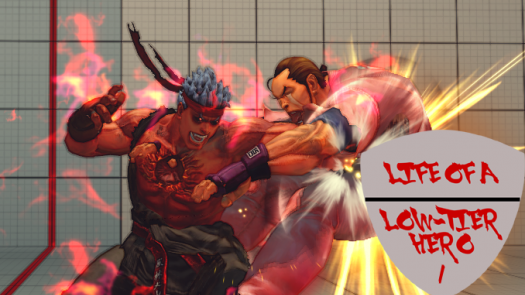
As long as fighting games have been around, players have ranked characters based on who is the “strongest” character in the game – and who is the weakest. Characters are often organized into “tiers” based the effectiveness of the character. Some characters owe their high-tier placement to the strength of their moves and abilities as they pertain to the current landscape of the competitive metagame (the game within the game.) Some, like Street Fighter’s Yun, can thank excellent character design to their power across multiple games. While some players gravitate towards the higher-tiered characters to win, some find using characters considered weak to be incredibly rewarding. The thrill of beating a Ken player with Sean in Street Fighter III: 3rd Strike or beating an Evil Ryu player with Dan in Ultra Street Fighter IV can provide players with pride winning with strong characters simply can’t match.
I’ve found that a tier list, in most cases, should not be concrete. Rather, it should be treated as fluid and dynamic, and should change along with the metagame. Just because a character starts at the bottom doesn’t mean that’s where they will stay when it’s all said and done. It’s entirely possible for characters to move their way up their respective tier lists based on new revelations or a change in the metagame.
For example, early in Ultimate Marvel vs. Capcom 3’s life cycle, characters like Morrigan, Phoenix and Zero were considered middle-of-the-pack characters that had no business being used on high-level teams. As the life of the game progressed, these characters were found to be stronger than originally anticipated and quickly shot up the tier list. Meanwhile, characters like Wesker, Amaterasu and Chun-Li were found to not be as strong as high-level players originally thought and were demoted as such. Had these players only used characters that were considered powerful at first, we might have had a completely different history for Ultimate Marvel vs. Capcom 3.
Shedding a Tier
In my personal opinion, marrying oneself to the idea of “tiers” is dangerous. I find that I’m much more successful in a game when I’m playing a character I legitimately enjoy versus playing a character that I’m only selecting because of their strength. However, I acknowledge the importance and usefulness of tiers for a fighting game. Tiers are a great indicator of the state of the current metagame and which characters I’ll to run into online and at tournaments.
Tiers placement might also be the decision maker for me when I’m stuck between two characters I enjoy. For instance, when Injustice: Gods Among Us came out, I was stuck between playing Bane and Superman. I originally sided with Bane because I enjoy the “grappler” archetype and love Bane as a character, especially when he is portrayed with the luchador motif. I wasn’t as successful as I wanted to be and, after looking at a tier list, realized I could have been playing Superman the whole time, who was widely considered to be the best character in the game. While I certainly stuck with Supes going forward, I made sure to give Bane some run every once in awhile because I still enjoyed him, even if he wasn’t as strong as my main.
This series will be an ongoing deep dive into tiers, their sometimes sacrosanct importance in fighting games, the evolving metagame that tiers affect and the players who choose fight alongside their favorite characters despite their flaws. Next week, I’d like to examine fighting game’s most famous joke character and master of Saikyo himself – Dan Hibiki.
Which characters would you like to see us cover? Or is there a certain game whose tiers you’d like us to examine? Let us know!