Pete Hines Talks Elder Scrolls: Legends & The Upcoming Isle of Madness
By Zac Cameron ·
While roaming around QuakeCon 2018, we managed to grab some time with non-other than Pete Hines himself to talk about the upcoming expansion for the Elder Scrolls: Legends, and how designing new cards works for Bethesda's virtual card game.
The Elder Scrolls: Legends, Bethesda's take on the virtual card game, has been rolling out steadily as the studio behind it continues to bring lore and functionality together with a fun, competitive experience, but how does it all come together? With the new Isle of Madness expansion announced at QuakeCon 2018, we had the opportunity to sit down with Pete Hines from Bethesda, who was willing to share his insight on designing a cool new expansion for a game like the Elder Scrolls: Legends, and the plans for the future of the game.
We have the announcement of the new expansion for the Elder Scrolls: Legends, can you take me into that a little bit?
“Only a very little bit. if you know your Elder Scrolls lore, you know Isle of Madness is the realm for Sheogorath, the prankster God of the Elder Scrolls universe. It’ll be a set, we haven’t really said more about what kind, but there will be a significant number of cards revolving around Sheogorath, his antics, and his domain.”
Just announced: Isle of Madness will be the next story expansion for #TESLegends! pic.twitter.com/Npk1CTaDB7
— Bethesda (@bethesda) August 10, 2018
When you look at a strategy card game like this, when bringing in expansions, there are considerations of what new cards can do with existing cards - are there synergies that can break the game or become unbalanced and need to be rebalanced? How has the team approached that?
“It’s usually a mix, it depends on the size of the set and what they want to do. We’ve done a variety of things, like introducing new mechanics like Charge, plots, or new functionalities like we introduced in Houses of Morrowind. We’ll also grandfather in concepts from previous sets and build it around a word. For instance, we added Slay - there were cards in the original core set that did exactly what Slay does, but we gave the new cards a word to make it easier to understand - if you kill a card and stay alive, it can gain +1/+1 or a different thing. It can be a mix of stuff, and then it can also play up synergies that weren’t there before, so cards that care about you having Colorless cards in your hands. Cards that may not have had much value before now can become much more interesting because this new card gives it an added value.”
When it comes to the development of new cards, would you say that the team works out the aesthetic, the lore, and the items of the Elder Scrolls universe first, or does functionality come first and the lore fill in around it?
“Sometimes one and sometime the other. Usually knowing where it’s going to be set (Isle of Madness) ...we have to consider how will the set be structured thematically? For instance, we might decide to build a set around three colors, but which three colors? Which feel right for the expansion lore wise, and which make sense from a mechanics standpoint? Why did we do LALU in the colors we did and not change a color here or there? That can be more from a balance standpoint, because two color pairs might be stronger in the meta than others, and then that House will be the only ones played. We have to make sure that only two of those colors appear in one House to avoid making them far too prevalent. I think what you’re seeing out of the Master series is that - hey, these are the types of decks people are playing and how many people are playing them for the first 16, and then during Day 2 in Top 8 - you see those decks shift around a lot.
You may know what colors people are playing, but you might not know whether they’re playing Warriors, or midrange, or aggro decks, or controlling decks. For instance, Siege Catapult is suddenly back, a card that hasn’t seen much play in forever. But all of a sudden, people are using silence effects to turn it on and start attacking or using cheap creatures to fill their lanes and get in for a lot of damage early on. That is what I think makes it very interesting and how the new sets and cards fit in not just thematically, but strategically. The most important thing to us is, ‘do the new cards freshen up the meta, add new value, open a new range of possibilities, and make the game more interesting?’ Because if not, no matter how cool they are, nobody will want to change their existing deck because the cards are kind of useless.”
Some Legends at the #TESLegends booth! pic.twitter.com/13Anw4pzt1
— The Elder Scrolls: Legends (@TESLegends) August 11, 2018
Speaking to that competitive side, many players we’ve talked to have said they moved away from Hearthstone, because of too much randomness and reliance on RNG sucking the fun from the game. Does the team see that as a foreseeable problem and how do they stay away from that with Elder Scrolls: Legends?
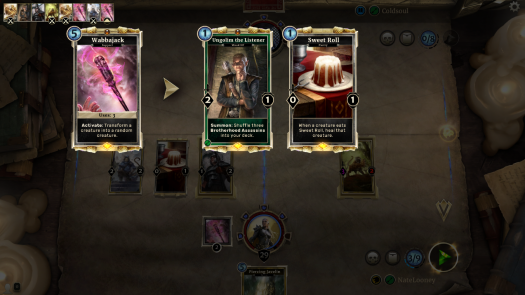
“Here’s our big picture philosophy - we want some RNG in our game, because people play strategy card games for different reasons. Some of that is to do lots of fun, silly stuff. The issue is can you include those things and have them be viable? Can you have a card like that in Arena, but make it useful? We have a card like Wabbajack, that nobody uses in anyone’s competitive deck lists, nor should it. But when you see it in Arena, you’re like, ‘oh yeah, I’m going to take this and do some silly stuff and see what happens.’ I think those kinds of things are good when they’re done in a kind of way that doesn’t make the whole game feel like RNG. I try to separate randomness and RNG - RNG is getting a card after playing Mud Crab Merchant. Randomness is like us playing Magic: The Gathering, and you getting four lands on your first hand. That’s not RNG, that’s just randomness. Some of that is still necessary in a card game, otherwise it turns into a game of chess. For example, people playing Blue decks might not use Lightning Bolt anymore, because they need other pieces more to complement their game plan. It’s not an auto-include anymore, but if you use it, you’re taking that risk.”
Speaking to the organization of competition for ESL, how do you feel about the future of the game when it comes to building this up? Is it just small events like QuakeCon, or do you see something larger scale like a league?
“It’s a good question, and I think what we want to do a variety of things at a variety of different levels for players. I want competitions where people are less experienced and want to have fun, but still have the ability to enter a competition. When they want to step up and challenge a higher level, they can take the next step and the step after that. I compare it to Paper Magic, where you have anywhere from Friday Night Magic to Grand Prix’s full of Hall-of-Famers to Pro Tour qualifiers. All of those things are viable and can cater to people of different levels of experience. I want to make sure what we’re doing is slow, and that we’re building it in the right way. It’s definitely a crawl-walk-run, and with this Master Series, we’re moving from crawl to walk, but I don’t want the next step to be run - I want it to be us walking a little better and better as we keep moving forward. Let’s make sure we’re growing this in a way that’s in touch with our community and higher-level players, and in a way that is healthy and sustainable. We’ve talked about in-game tournaments for a long time, one of the features of a new client. It will allow any user to host a tournament and broadcast it if they want.”
With that, it would appear we can look forward to new details on competition, tournaments, and the new Isle of Madness expansion in the near future. For more Elder Scrolls: Legends action from QuakeCon 2018, check out our interview with the ESL Master Series QuakeCon 2018 Tournament, PlzDonHakMe.