Son Of A Frankfurter! That Hot Dog Just Beat Me At Fighting Games!
By Jeff Kotuby ·
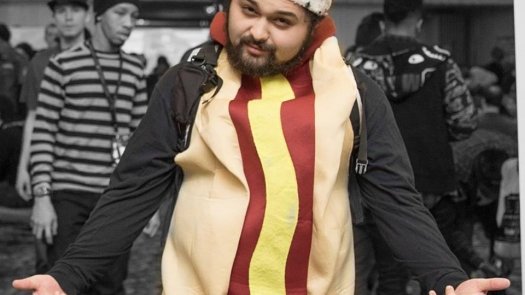
The fighting game community's number one processed meat product, Jon Nitti, is a sight to behold. The man behind the hot dog sits down with Twin Galaxies to discuss how much better past fighting games were, the current state of fighting game esports, and of course, traffic.
Banner photo credit: Chris Bahn
We’ve seen various video game personalities dressed up as a multitude of different creatures. From foxes to sunglasses and moustache wearing villains, we’ve got it all. But, have you ever seen a guy play fighting games as a hot dog? If so, then you’ll know our latest interviewee, Jon Nitti. We sat down with the fighting game frankfurter for his thoughts on the past, present, and future of fighting game esports.
The Early Years
Nitti was born in New Jersey but now calls Atlanta home, for better or for worse. Our conversation was delayed due to the famous Atlanta traffic, of which Jon said “...it takes an hour and a half to go 15 miles.” His first fighting game memories consist of playing Mortal Kombat II and Street Fighter II at his cousin’s apartment and dressing up as Sub-Zero for Halloween. Nitti took a break from fighters before getting back into them as he got older. “Fighting games have always been a core part of my life, but when I rediscovered them on my own again when Link was announced in Soul Calibur II. Link was my favorite character and I had to have it.” In order to prepare, Nitti went to GameStop right after and bought Soul Calibur and a Sega Dreamcast and went to work, using Xianghua to do battle.
Like many, Street Fighter IV was Nitti’s first real venture into the fighting game community (FGC) “I couldn’t really play the games I wanted to play with my friends from high school, so I got into the FGC in order to find people to hang out with an play the games I wanted to play.” That being said, his first real competitive fighter was Soul Calibur V. “I did pretty good at a local event for Soul Calibur V and people really seemed to want to help me get even better,” Nitti said. “I figured at that point this was something I enjoyed doing and I figured I might as well try to be the best at it.” He admits that he never got to that point to be the best, but he still had fun no matter what!
What’s On The Menu Currently?
At this point, Nitt is focusing his time on Injustice 2, more so than anything else. After playing so much of the first part of the series, he said he was drawn to it because, “it was like nothing else I’d ever played before. It was fun, everyone knows the characters, and there were aspects of Injustice that were in no other game at the time.” Nitti mentions he enjoyed the use of interactables because like in Soul Calibur, “stages matter.”
Nitti was equally as excited about Injustice 2’s representation at eLeague, exclaiming that it was “f---ing awesome” when asked about it. “I went to a Street Fighter V taping,” Nitti said, “and the presentation is absolutely great. For Injustice 2, I thought the commentary was personally very good, but the community didn’t seem to like it because it wasn’t commentators more in the community.” Nitti mentions that while Twitch numbers weren’t great, TV numbers were, and to us, that was really all that mattered.
The Future of Fighting Game Esports
Our conversation turned to one of the future of fighting game esports. While other games, like Counter-Strike: Global Offensive and League of Legends have attracted major viewership numbers across media platforms, fighting games have been struggling to reach those same numbers. Street Fighter V and the Smash Bros. series of games tend to do well, but what of the rest?
“I feel like fighting game developers have never hit the mark with esports,” Nitti said. “The game that did it the best was Street Fighter IV, just based on the growth we experienced during that time. The biggest thing is that fighting games are still marketed as console games, not esports titles on PC. When you play games on consoles, you cut out the biggest investors in esports - computer hardware companies that put up these large pot bonuses to show off how good their company is. On console, who do you have? Just Microsoft and Sony.”
We talked a bit more and thought that, yes, the PC version of a fighting game is almost always the preferred option. “The PC version always looks better, always runs better, some Netherrealm ports aside,” Nitti said, “so why not give the main sponsor of esports the opportunity to showcase their products? They’re willing to drop the cash. It’s great that we have Totino’s, Red Bull, and Cup Noodles, but imagine if we had all that plus computer hardware companies?”

Caption: Nitti and Injustice 2 guest character Hellboy
How Can We Reach These Players?
Jon laid out a number of problems that contribute to fighting games’ lack of mainstream awareness, the first being the lack of a free-to-play model.
“No fighting game developer has done free-to-play correctly, and the some of most successful esports games run on that model. Fighting games take a much larger investment - full price game, plus DLC characters that cost money.
We discussed Capcom’s business model, and we concluded that unfortunately for Capcom, players don’t want to pay for the game and skins. While the idea of a “Cammy bundle” where you unlock the character and all their costumes & colors seems great, its convenience is lessened when players have to purchase a full $60 game, too. In order to succeed, it has to be one or the other. “When you don’t pay for the game,” Nitti said, “you don’t think about dropping 20 bucks on skins.”
Second was the idea that fighting games don't tell you when their events are on! “There is no esports game that does not shove the esports events in their players’ faces - except fighting games." Nitti said. "SMITE does it, Overwatch does it, I don’t know why fighting game developers don’t take notes from these developers and do esports the right way.”
“Another place where fighting game developers mess up is in accessibility to players." Nitti said. "CS:GO and DOTA2 are both incredibly popular, but are very unforgiving to new players. If you find yourself in the wrong place at the wrong time, you’re going to die. Low-level players aren’t going to invest the time to get better like the pro players will. On the flip side, Overwatch is easy for new players to get into and do well in.” Nitti said the problem with Street Fighter V is that most characters have the same gameplan. In SFIV, characters tended to be very different, in SFV, these characters are all played exactly the same way, leading to "boring" matches that aren't engaging to new players.

Caption: Jon Nitti in the famous hot dog costume, readying up
A Bright Future:
For Street Fighter V, there is hope. Nitti reminds us all that Street Fighter III: New Generation was “god-awful.” “In four or five versions, I think the game will be pretty nice.”
I agreed. I love the music, the lobby, the graphics - which means that all that needs to catch up is the gameplay. Like I said to Nitti, “They tried to cater to casuals and high-level players and ended up catering to no one.”
Nitti also reminded us that the new version of a fighting game, especially Street Fighter, is the game it’s cool to talk smack about. “Even with Street Fighter IV,” Nitti said, “there were Third Strike and ST (Super Street Fighter II Turbo) players constantly talking sh-- about it when it first released.”
Nitti had one last point, saying, “I wish people embraced esports more, unfortunately fighting game developers think it has to be streamlined - which isn’t the case. The players who play CS:GO and Starcraft II don’t change for corporate sponsors, so why should the fighting game community change for it?”
Follow Jon Nitti at his Twitter. For more in-depth player interviews, check out our interview with HB|Punisher!