Growing Esports Academics - A Chat With Shenandoah University's Joey Gawrysiak
By TJ Denzer ·
Shenandoah University has announced one of North America's first multi-trac Esports college majors and Professor and Director Joey Gawrysiak spoke to us about how it came to be and what he hopes for it to become.
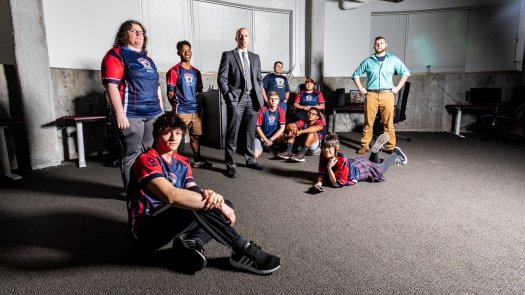
The future in esports is bright to say the least, but it’s also much less of a wild west than it used to be. Organizational needs have spawned countless careers in the field well beyond simply playing the game. From coaching and psychology to media and administrative management, esports is an industry like no other and its growth has been nothing short of exponential in the last decade with no sign of stopping in the future.
Shenandoah University in Winchester, Virginia has taken note of the trend and they’ve chosen to help prepare students to face it head on. They’ve recently established Esports as a Major and Minor curriculum at the college. With Director of Sports Management, Esports, and Esports Academics Professor Joey Gawrysiak leading the charge, Shenandoah is set to be one of the first universities in North America to offer this field of study. Himself an avid player with years of interest in competitive gaming dating back to Halo, Professor Gawrysiak has long seen esports as a field which combined his two passions of sports and gaming. With Shenandoah’s new Esports Major rolling out under his direction, Gawrysiak took the time to speak with Twin Galaxies about how this academic venture came to be and what he wants it to become.

Twin Galaxies: How did the university decide on the focuses for the Esports Major program? What was the criteria in deciding what you felt would be most relevant to an esports business education?
Joey Gawrysiak: They came from me as well as a consultant that we brought on board that has been researching esports for the last four or five years - Dr. Seth Jenny from Slippery Rock University. He’s focused on a more sports science side of esports, but he and I have been working together on what I wanted this major to look like. There’s so many different things to study in esports. There’s certainly the management side and I think that’s a big side of it, but I wanted to offer more than just that. It’s one major in the Esports program, but we actually have different tracs within the Esports Major, which are Management, Media & Communication, and Coaching. Those concentrations came about because we looked at what the industry is demanding and we saw where a lot of jobs in the esports industry were going. Even further, students can major in Esports without selecting a trac if they choose to. They’re not forced into doing a trac if they want more of an all-encompassing view of the industry. These curriculums also work because even if they don’t want to work in Esports, these tracs still work well with other things they may want to do for a living. For instance, someone taking the Esports Management trac would also be required to get a Business Minor because these things often go hand in hand, so if they don’t work in Esports they’ll still have a business education to help them find something else in another business-centered industry. There is an Esports Minor as well. The Minor includes two tracs - Management and Sport Science. It’s meant to augment whatever the student is majoring in. With certain standards set in place, a student in Business School couldn’t really major in Esports Management, but they could get a Bachelor’s of Business Administration and minor in Esports Management, while still meeting the requirements set by the AACSB rules.
TG: What has the early reaction to this program been like? From students, staff, and parents?
Gawrysiak: The students love this. I was already telling them what was happening during advisement time before the program was announced, and a lot of them who were either playing on teams at Shenandoah or taking the esports class I was teaching really wanted to know more about the industry and figure out how to work in it. We had a lot of students who wondered if this might happen and asked how they could prepare for it. And that’s just inside the University. Outside, we’ve had high school students and prospects showing interest as well. I talked to students and their parents who were interested in doing this. The parental response has been pretty limited to students who were already interested, but the ones I’ve talked to have been very positive.
There was a social media post brought to me by a student questioning where the University priorities lie when they’re putting money into this instead of elsewhere, but when I can put the numbers down in front of them and show this industry is certainly worth consideration, most people have responded well and they see that their kids are happy and have a passion for this. As for faculty, there’s been questions about where it fits into the current curriculum and what the students are getting out of this that they can’t get elsewhere. For that, I’ve met with professors, done presentations, walked people through the industry, and where the interests and priorities are for students and the organizations looking to hire. Certainly, there has been questions, but we’ve also worked on building those bridges where other faculty can see where this program fits with other studies and works off of what the students are learning in other classes.

TG: What steps will Shenandoah take to educate parents and others on this major? There is bound to be a lot of concerned parents who think their kids should be majoring in a "safer" field like accounting, business, etc. How do you address that?
Gawrysiak: Esports is very much in a place where Sport Management was years ago when it started. People were literally saying, ‘Why are you studying football? There’s no industry there. No jobs. That’s not a real academic major concentration.’ But people in the industry insisted on looking at this and continuing to ask and pursue the questions it would take for this to become a legitimate business and commercialized product, and now the Sports Management Major has bloomed and is extremely popular around the world. Hundreds, if not thousands, of universities are offering it, and I see Esports as major in a similar place. It’s a matter of growing this field into something just as Sports Management did and making sure students, faculties, and parents understand what makes this major uniquely something that they can’t get in another area of study. The biggest thing is getting in front of the people and being able to talk about this.
TG: The University is also taking a greater step in competing in collegiate esports with both the establishment of a NACE VR team and efforts to engage in many other games. Are students of this program encouraged to compete or simply work beside the teams Shenandoah is promoting?
Gawrysiak: The students are encouraged towards a little bit of both, but it’s not mandatory. I would never force an Esports Major to compete. That’d be like demanding that a Sports Management Major must play a sport to continue their study, so it’s not a requirement. If students want to compete, they can definitely go in there and play alongside teams. That said, all students of this major will work with ours and other competitive teams in some capacity. It’s nothing short of a benefit to students in this field to get experience working with competitive players and teams, whether it’s helping on the coaching side or other aspects. Part of the requirement of all tracs of the Major is 6 hours of experiential service and helping with coaching, practices, and going over game film counts towards that. Management tracs will be pushed towards going to events, helping with revenue generation, marketing the team and other business and administrative focuses for that 6 hours. Media and Communication is all about Twitch, streaming, videos, and social media, which are the lifeblood of esports viewership. They’ll work with the team to create personalities, create broadcasts, and understand how to build a presence online. There’s a lot of experiences already in place here on campus that will help these students understand what they’ll be dealing with beyond their academic career.
TG: With livestreaming on platforms like Twitch being such a big factor in PR for esports these days, what kind of efforts does the program put towards livestreaming performance and technical knowledge?
Gawrysiak: The way we set up our program with streaming is by partnering with our students in the VR lab. We have a VR Major and we’re working with those students to create an environment where students will learn by doing things hands-on. Setting up OBS, Twitch, and such are very technical subjects and we’re not a technical school. That said, we are growing when it comes to technical elements like that. We already have computer and cyber security classes, and I can see another trac for Esports down the line being one of technical design and efforts that go into create and handling the tools competitive players and content producers work with in this field. That’ll be a major possibility in the future when we are able to hire faculty for the roles. For now, our Mass Comm faculty also helps in teaching students how to set up for streams, cameras, camera angles, microphones, and lighting and other parts of the production side. There’s a lot of people in place here to help the students learn what they need for streaming and production.

TG: How confident are you that these students, upon graduation, will be able to find jobs in this field? Is the university assisting with job placement?
Gawrysiak: It’s hard to say yes that any student will get a job when they graduate. It’s not like they walk across that stage, take the diploma, and end up in a job interview on the other side. Obviously, the students need to put in the work to make the connections and find their place out there. That said, with the industry growing as it is and with places posting job openings regularly from management, to coaching, to sports medicine, to media, I feel confident in saying we’re building the curriculum that will give them what they need to pursue those opportunities if they want them and are willing to put in the effort.
TG: With online harassment being such a difficult topic to work with in the esports realm, are there planned courses and lessons to help students be better prepared to handle toxicity?
Gawrysiak: Something we tell our students regularly is that you have to watch your language. We are fully aware of the rage-quit mentality and the toxicity that has been present in video games in general. So, one part of our studies, and a part of the 100 level and 200 level classes I’m writing, has actually been dedicated to teaching students how to conduct themselves in various parts of the scene. It’s tough when you’re dealing with 18-to-21-year-olds who are in a tense, competitive environment and are used to saying certain things without thinking about it, but when you’re streaming, there are so many things you’re representing and there are certain rules in place that you have to abide by, especially when you’re sponsored or representing an organization. Twitch has an 11 to 12 page document that we had to sign where Shenandoah’s competitive teams are locked into certain behavioral requirements. We have to represent ourselves accordingly, and so we train our students to understand how to do that on camera - what you can and can’t do. Sometimes it’s easy and sometimes it’s a bit more difficult to corral these young adults, but there are legal and ethical implications that have to be addressed and we certainly aim to do it inside and outside of class.
TG: Are there plans to attend esports events where students can gain hands-on experience? What kind of contact have you established with esports teams, organizations, and event coordinators and companies to make sure your students will have access to the best environments for learning their place in the field?
Gawrysiak: Absolutely. Students actually going to events is one of the best ways to gain hands-on learning. We’ve had contact with ELEAGUE where we asked if we could bring students in to tour facilities and get a feel for events and their quick response was that they’d love to invite us out and make it happen. We’ve also talked to folks like Blizzard Entertainment. They wanted us out to help work BlizzCon this year, which was tough considering we were still rolling this out at the time, but it’s certainly something on our radar for the future. I’d love to give our students hands-on experience working with things like the Overwatch World Cup. More locally, we’ve had contact with SmashCon saying we’ll be able to help out in the Summer, there’s MAGFest in the area every January that features competition as well as academic panels, and professional esports player James “Clayster” Eubanks of eUnited who is a local pro that wants to get involved with the program and get us involved with eUnited as much as possible. We’ve also had contact with Mark Ein, who owns the DC Overwatch League team, about doing viewing parties, getting the team out to meet the students, and other opportunities. So there’s a lot of connections being made to make sure that hands-on experience and opportunities for our students will be abundant and we’ll get students to as many events as our budgets will allow.

TG: With the esports landscape ever changing, how does Shenandoah’s program intend to stay ahead of the curve and remain cutting edge when it comes to training students for this field?
Gawrysiak: It all starts here with me. I have to do my best to stay ahead of the curve and know what games are growing, what patches are changing games, what events are popping up, and more. I’m not alone, but we have to work hard on making sure we keep up. It’s hard to know what’s going to take off and what’s going to fall off in popularity. It’s all about being nimble in the space and observing where the jobs are. If media or coaching or sports science in Esports are seeing a growth in jobs, I’ll push our resources towards that field to make sure we’re attracting students to train to fill those roles. We have to make sure we’re talking to the industry, chatting with collegiate esports staff around the scene, and seeing where the trends are to try to figure out where it’s all headed. Nobody knows where this is going to be 5 to 10 years down the road, so we just have to be adaptive and communicative to do our best to figure it out, predict it, and try to stay ahead of wherever the esports industry goes.
With esports continuing to grow, Shenandoah University and Professor Gawrysiak are in a unique position to grow students and their program alongside it. The landscape of competitive gaming is a vast and constantly evolving one, but if Shenandoah can be successful in their efforts, it may just lend a hand in paving the way for more esports-related academia.
The Esports Majors and Minors at Shenandoah are expected to roll out in official capacity in Fall of 2019. You can learn more from the Management, Coaching, and Media & Communication tracks on the website. You can also follow Shenandoah competitive gaming on the University’s official Esports Twitter.
(Featured Image by Jason Lopez and Scott Spriggs/Shenandoah University)