Reveling in Winter Brawl's Lesser Known Fighting Game Communities
By Jason Fanelli ·
Games like Street Fighter and Tekken often get top billing, but there are plenty of games that some might not even think about when attending a fighting tournament. At Winter Brawl, we spoke to attendees to learn more about those communities.
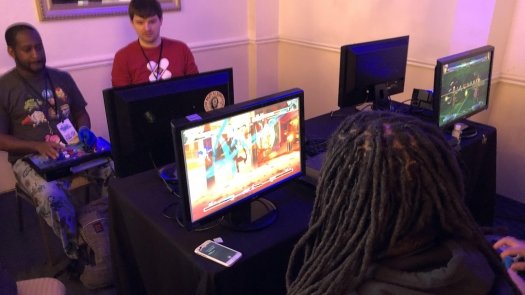
Street Fighter. Tekken. Injustice and Mortal Kombat. These are just a handful of games that everyone expects to see at a fighting game tournament. Their communities are thriving with hundreds of players per competition, and the companies behind them support them as much as possible. However, no tournament on the circuit (that isn’t directly sponsored by the company that made it) is an one or two trick pony; there are a wealth of fighters to be played with communities just as strong, even if they’re a little smaller.
Winter Brawl XII is a perfect example of this. While Dragon Ball FighterZ, Injustice 2, and the other examples I mentioned before dominated the main ballroom, there were two other rooms bustling with players of games I hadn’t even heard of before. These games are thriving outside of the spotlight, and it’s all thanks to the people that continue to play them. What can be done to ensure that these off-the-radar games continue to be supported? I spoke with a couple of players in those tournaments to get their thoughts.
Sometimes all it takes is a new game to be announced to get the competitive scene in its predecessor growing again. Such is the case in the Soulcalibur V community, which according to Robert “Patriots1112” Seal is already seeing a big difference. “The scene is already starting to boom again,” he said. ”As soon as the game was announced the community was in an uproar.” He only has one request for the new game, if Bandai Namco is listening: “I only wish that Voldo is present and accounted for.”
Conversely, a publisher announcing the end of support for a current title could see a drop in attendance for future tournaments. That’s happening with Dead or Alive 5: Final Round, which finds itself losing some players due to a lack of support. I spoke with DOA5 Winter Brawl 12 champion Daniel “Jager” McMahon before his victory about the DOA community, and he could already see a slip in the numbers.
“This last December we had players from all over the world, 130-140 total playing for a $6K pot bonus,” Jager explained, “but then the developer Team Ninja came out and said they wouldn’t be supporting a full circuit for the game. There’s been a little drop in the numbers since, but we still have people coming out to the events and that is great.”
Jager also jumped into the tournament for Under Night In-Birth EXE:Late[st] at this year’s Winter Brawl, a game he feels might attract more people than it gets credit for if they just play it. “It’s an anime fighter but it plays a lot like Street Fighter,” he explained to me. “It’s not as chaotic with multiple assists on screen at a time. A lot of my Street Fighter friends like the neutral game in Under Night. It’s got similar bones and fundamentals so longtime players of other fighters can get pretty far pretty quickly.”
The most important part of building a strong community, however, is maintaining a solid foundation. Jumaani “Maestro” Haskins, who signed up for both Super Street Fighter 2 Turbo and Under Night at Winter Brawl XII, emphasized how important getting people together locally can be. ”A local scene helps so much,” he said. “If you build locally, the regular members improve and start getting more attention at regionals majors, then big time majors like EVO are going to have the game.”
No matter how small the community is or how many players may enter a tournament, Maestro thinks any game, with enough interest, deserves a chance. “I think you just have to give it a shot,” he said after I asked what he would say to an organizer if given the chance. “I know logistically bigger tournaments might not have the room for it, but give these games a shot on the main stage, to be seen by everyone, because with visibility the scene will grow.”
The big games will always have a spot at the table of the major tournaments, but lesser known titles and their communities are just as important in keeping the FGC fresh. With a little more exposure and some developer support any game can rise to the top of the fighting game heap, and as these players have shared there’s always some room for a smaller game to grow.
Looking to get into tournament play on your own favorite fighting game, but don't know where to start? We talked to some first-timers at Winter Brawl about their experiences and got tips on how to approach your first competitive fighting game scene!