Bill Bastable Obliterates Super Pac-Man...again!
By Twin Galaxies Editorial Staff ·
First he conquered Pac-Man. Now he's back decoding the game's sequel
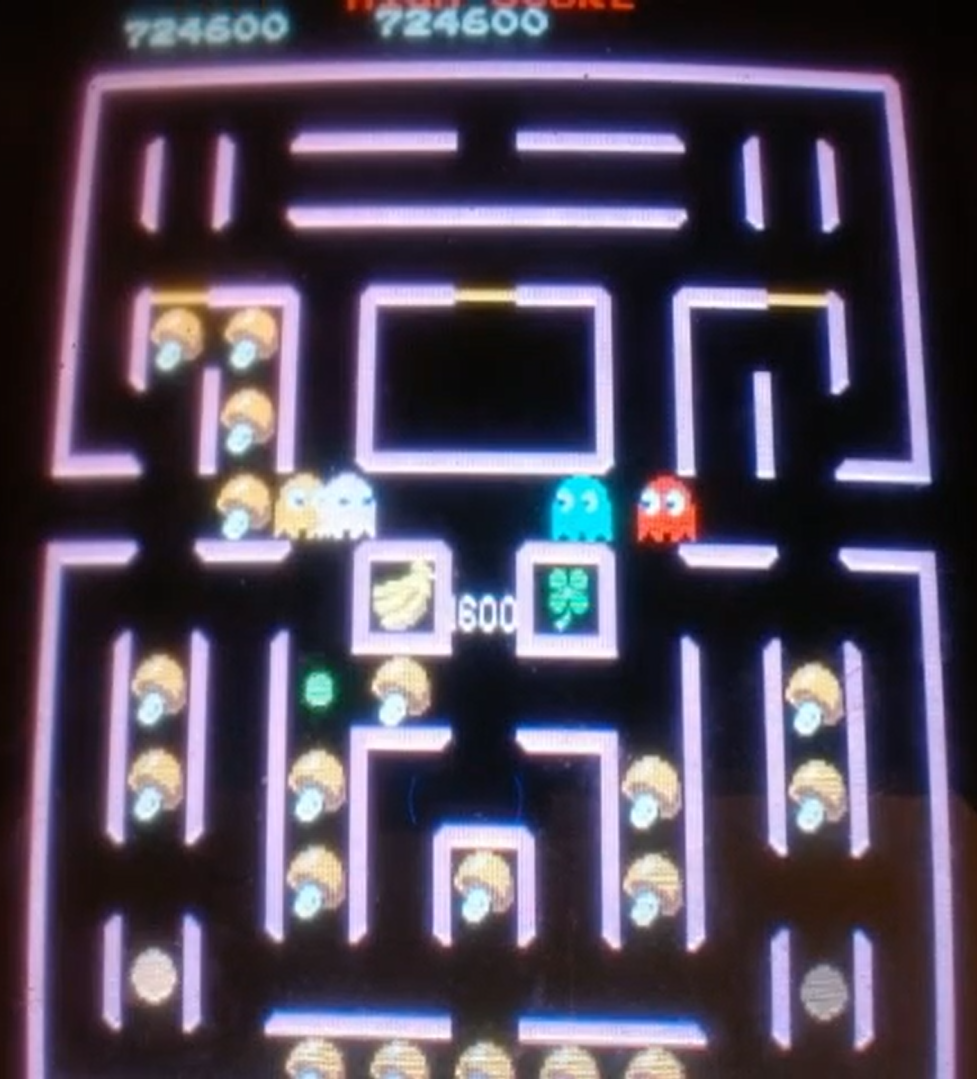
Howdy folks! This is ersatz_cats, dropping in on behalf of Twin Galaxies Editorial for an update on the life and times of original Pac-Man legend, Bill Bastable, and his quest to demolish Super Pac-Man once and for all.
WHO IS BILL BASTABLE?
Two and a half years ago, when I had some unrelated matters in Florida, I was able to take a detour to visit the one and only William Talbot Bastable, currently residing in Sarasota. For those who don't know, this guy is Pac-Man royalty like no other. He doesn't quite predate other early legends like Randy Tufts, nor does he compete with the standing modern champion of original Pac-Man David Race. But what Bastable does have is his name on a letter from none other than Bally-Midway, congratulating him on a perfect score on Pac-Man all the way back in 1982.
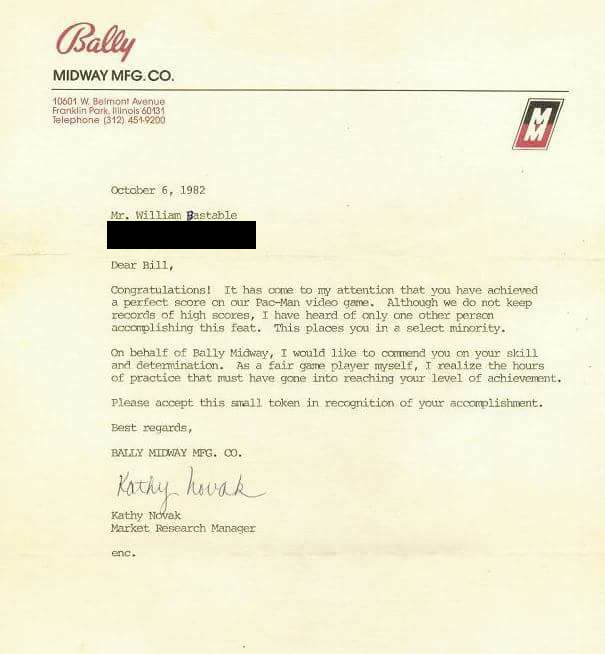
This was in recognition of Bill's first perfect score of 3,332,820, achieved in November 1982. He would go on to replicate the feat five more times in the coming months. This was before the gaming public had been made aware of the regenerating hidden dots on the game's final screen - the infamous "split screen" - which can account for a potential 540 bonus points. As Bill was operating on his own, out in the gaming wilderness, without the guidance of any official rule set or organized adjudication, it made sense to treat those not-yet-understood dots as off-limits - a strange residue of failed computer code run amok. And given the letter he received, it seems the American manufacturers of the game felt the same way.
However, the bonus points would not stay secret forever. A few years later, an encounter with another '80s Pac-Man master, Chris Ayra, brought these glitched dots into Bill Bastable's crosshairs. As a result, Bastable is today best known as the first player ever to achieve a score of 3,333,360 on original Pac-Man.
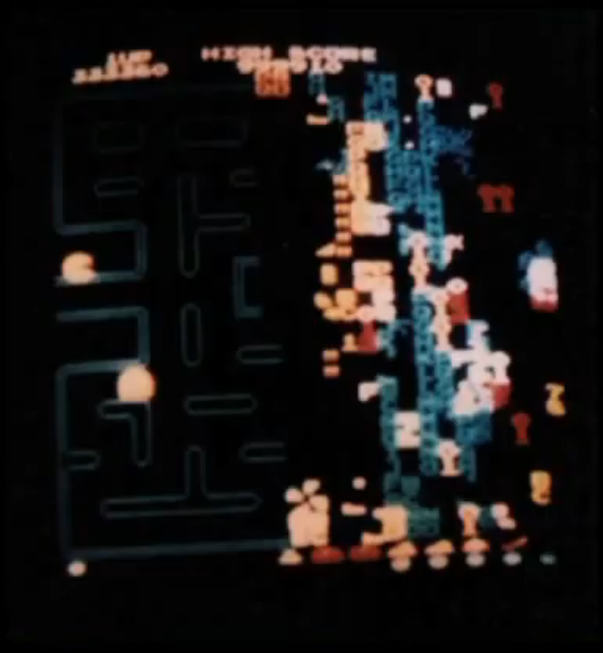
This score has an overwhelming amount of proof relative to gaming achievements of its era. A photograph of the game screen including the final score is printed on photo paper dated 1988. Bill Herald, a reporter for Sarasota Herald-Tribune, kept his own contemporary documentation of Bastable's quest. But again, Bastable was operating on his own, without any official rule set, at a time when centralized arcade high score competition was nigh non-functional. By his own admission, he used the game's internal dip switches to pause his game - something we would never know he had done if he hadn't acknowledged it himself. This would disqualify the score by today's standards, but again, there was no governing body at the time saying this was unallowed.
NOW YOU'RE PLAYING WITH SUPER POWER
Here's where I come into the story. I was first put in touch with Bastable in 2021, as I was working on a big video game history research project. While Bastable was happy to answer individual questions, he declined a full recorded interview, as he was obsessed with developing a mastery of one of classic Pac-Man's derivative games, Super Pac-Man.
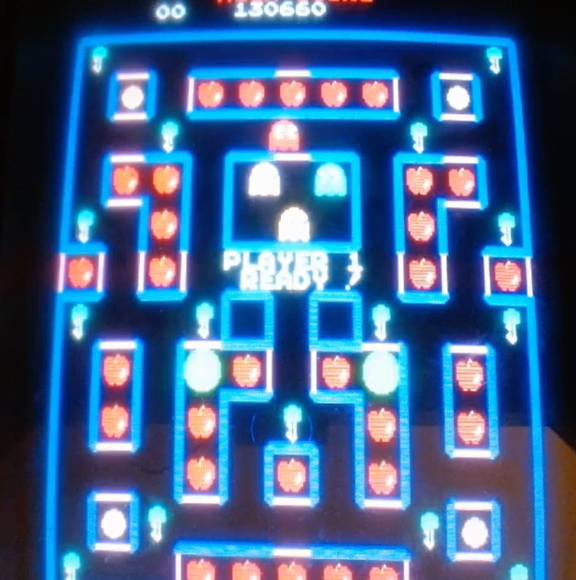
I won't pretend to know everything involved in a game of Super Pac-Man. The basic Pac formula still exists. You guide a yellow muncher around a maze. There are still four energizers that turn the ghosts blue. The basic dots are replaced with fruits strewn about the board. The central fruit is replaced with a star, which grants a variable amount of points. There are now gated walls, which can be opened by collecting the correct keys. There's an additional speed button, granting Pac-Man a limited velocity boost. And lastly, the big green dots turn Pac-Man huge, allowing him to bust through those door gates, as well as pass through the ghosts unharmed (although those sinister spirits can still only be eaten by way of classic energizers). In my conversations with Bastable, he lauds this game as the equivalent of an advanced college course relative to the introductory 101 and 102 classes of original Pac-Man and Ms. Pac-Man.
In our phone conversations, he frequently expressed the desire for someone to assist in recording his developing Super Pac-Man patterns. You see, Bill Bastable is a unique breed of technologically-illiterate gamer. I can't say he doesn't have a computer, because he technically still has an old IBM relic, emblazoned with a "Windows 95" sticker. But by today's standards, he lives a hermit's life, without modern computing or Internet access. His only connection to the outside world is a classic flip-style cell phone, with which he only knows how to make and receive calls. Having been born in 1961, this way of life may track with his age group, but when you throw in his well-worn multicade machine in his front room, this does place him in a tiny but growing category of active gamers over the age of 60.
When I had the opportunity to visit him in January 2023, I put to him the following offer: I'll record your Super Pac-Man patterns if you grant me an interview. I referred to Bill Bastable as the JD Salinger of video games, in that interviews with him were scarce. The man was true to his word, and both his interview and his Super Pac patterns, as well as a bonus high score on Mr. Do's Castle, were soon published for the world to see:
However, the ever-competitive Bill Bastable was still not satisfied. My 2023 trip to Florida was on relatively short notice, and so too was my offer. This gave him little time to polish his final Super Pac product. Bill didn't complain or make excuses, but he did continue working at developing his patterns further. Every time I spoke to him after that visit, it was "I've figured out a better ending to boards 1, 4, and 12, and a better path to the energizers on boards 13 and 15". He would always assure me these patterns are finally fully optimized, only to relay a couple weeks later that he had tweaked them further, and now they should be final, before reiterating the process again. Eventually, these updates slowed, as his work neared its true completion. And all the while, his urgency for a recording do-over grew. There were other pursuits he wanted to turn his analytic brain toward, but he couldn't do so until he knew these patterns were safely recorded.
Living on the far opposite corner of the country, I had no intention of being the one to fly all the way out and record his patterns a second time. Surely, a local friend could do this. However, like many aging members of our communities, Bill Bastable leads a lonely life. It's not that he doesn't have a few friends and family still around. His sister's boyfriend Randy even purchased him a GoPro camera to aid in his game recording. However, unsurprisingly, Bill has no idea how to use the darn thing. What Bill needed was someone to bring their own equipment and be prepared to sit and hang out during his failed attempts at this decades old game. And in this modern world of entertainment saturation and infinitesimal attention spans, it seems this was the one thing his few acquaintances were unable to do.
Finally, in 2025, a personal opportunity arose on my end. Once again, I would extend a visit to Bill Bastable, this time with no requirement of interview. And after two and a half years of work on his part, we would once again record what he assures me are definitely his final Super Pac-Man patterns.
THE FINER DETAILS
Let me start by reemphasizing that I am not a qualified expert on Super Pac-Man. I would encourage anyone who plays the game to add commentary of their own. However, with the ability to watch 2023's pattern set side-by-side with Bastable's new recording, some things have stood out:
The last sixteen boards of Super Pac-Man repeat after screen 44, making that Bill's cutoff point. Unlike the notoriously glitchy conclusions of other early Pac-Man games, Super Pac has no "kill screen". Thus, the game can be marathoned indefinitely. As a result, Bastable's approach to crushing the game is to optimize those 44 boards, as if they were a category unto themselves.
These patterns collect almost all available points (I'll get to what exactly that means in a moment), but with near-perfect points as the base requirement, what these patterns really focus on is time efficiency. They're like a hybrid of high score play and an arcade speedrun.
As expected, some boards retain the same patterns as before. This includes screens 14, 17 through 20, and several of the late boards where ghost points are not a factor. There are also screens like 13 and 21 which feature only late deviations for minor skips. The patterns for 5 and 9 were completely overhauled, giving Bastable some of his largest time-saves. However, the bulk of the improvements come from mid-board deviations, all of which add up to his largest optimizations. Board 2 features a major detour, netting a 13-second gain. Board 8 now skips 17 seconds of pathing. And boards 4 and 16 each granted Bastable nine seconds of time saved.
Starting with board 3, every fourth screen is a bonus board, with no ghosts to worry about. No improvements were made to these safe boards. Bastable asked me to relay that his bonus board pattern is optimized for right-handed play, and that he would recommend lefties mirror his path, but only for those boards.
By my count, the new patterns shave approximately two minutes (more like 118 seconds) from his previous run. The reason this is only an estimate is because of the randomized star bonus:
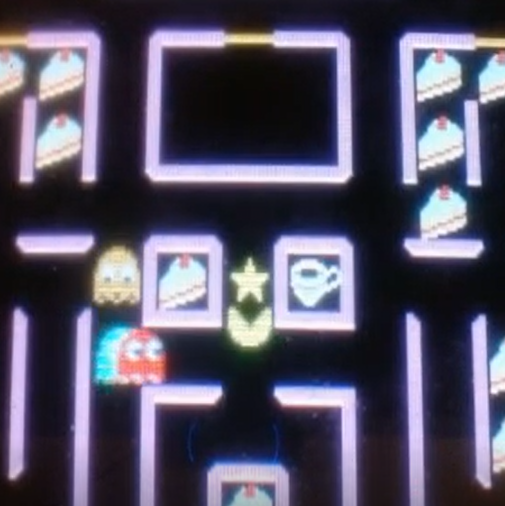
This star is flanked by two flashing symbols, flipping through the game's different food icons as if they were a slot machine. If the icons do not match when the star is eaten, you get a meager bonus, and the game goes on. However, a match results in an extended fanfare, and a larger 2000-point bonus. And, if that match also matches the food icon of the board you're on, that point bonus is upped to 5000.
It does not seem these bonuses can be manipulated. I base this on the fact that Bastable ran the same starting patterns on many boards, and many times he gained or lost time simply on account of landing a star match. This is why measuring the time saved by the new patterns is not as simple as lining up the two videos and comparing the total minutes and seconds of both runs. The good news is, this extended fanfare does not alter the patterns, or ghost behavior, or other RNG. If you're watching these runs side-by-side, and sync them up after the star bonus, those matching patterns will play out exactly the same as before.
There was one other peculiarity which caught my eagle eye:
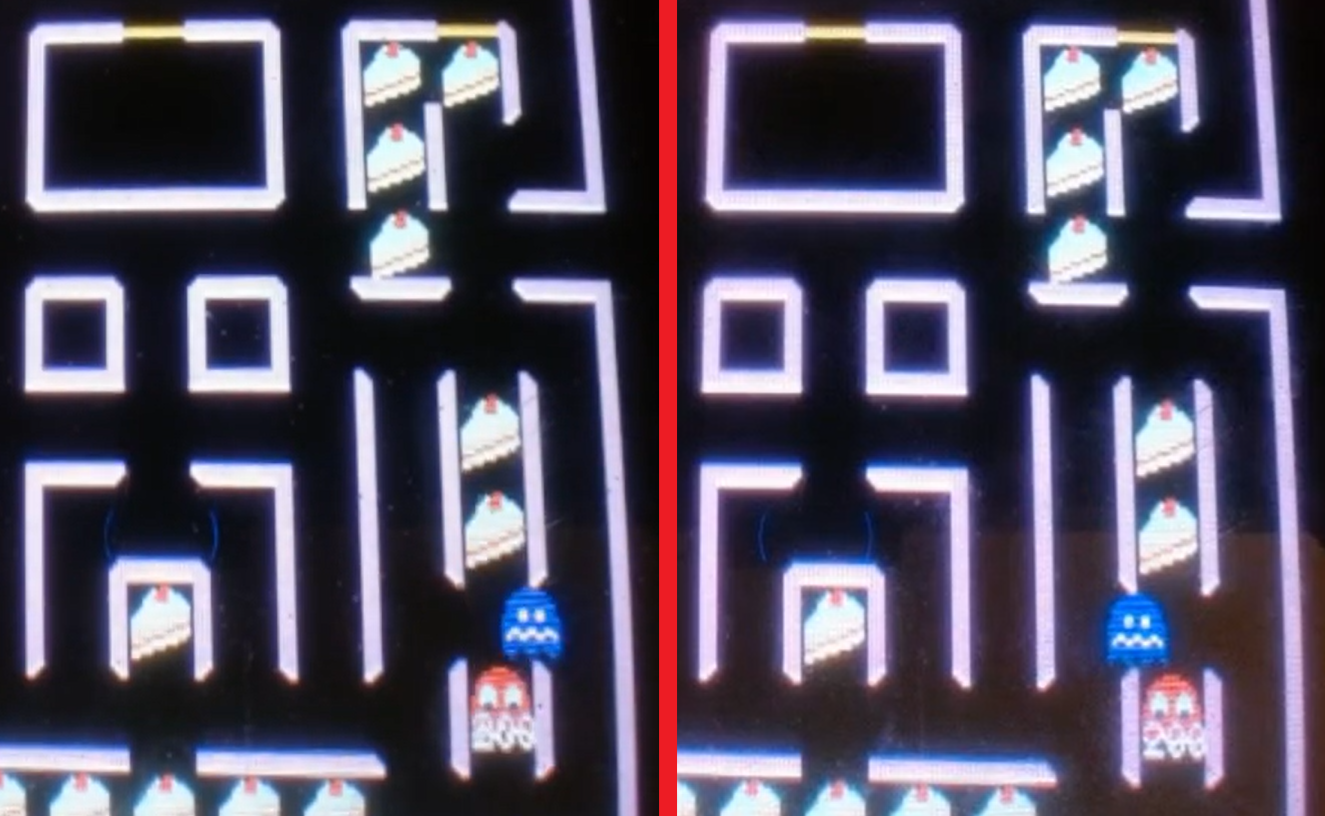
I'm used to classic Pac-Man patterns where all movement is accounted for. As long as you execute correctly, the ghosts are always in the same locations. And so, while reviewing board 24, it surprised me to see Clyde take different turns between Bill's 2023 and 2025 executions of the same pattern up to that point. Did Bill mis-execute his pattern? Unlikely, as both variations played out as intended from there on. I pointed this discrepancy out to him, and he explained that Clyde will react randomly at that location, turning in any direction, and that the remainder of the pattern accounts for this.
While the patterns seen on screen tell most of the story, there is the additional factor of the speed button. How does one design a "continuous motion" pattern with such a feature? Bastable explained that this was typically used at the end of a board, either to finish early, or to cut in front of a pack of ghosts while cleaning up the final icons. Another way to maintain consistency is to buffer it with certain events. On boards 9 and 10, the boost is used with the northeast energizer, however board 9 speeds all the way through the 1600 ghost, whereas board 10 lets off the gas at 200. While Bastable's directional movements can be mimicked, any aspiring pilot for these patterns would also have to discern and replicate the exact stretches when the boost is used as well.
I really cannot over-emphasize how impressive these patterns are, even if we limit our discussion to the routes themselves. The amount of time and work it must take to develop these from scratch is mind-boggling, especially when you consider Bastable made no use of MAME tools or rack advance. Even more insane, Bastable doesn't seem to have kept any written notes!! He's been holding these in his head for years, all while spending his days tweaking and refining them. No wonder he's happy to have them finally recorded for posterity!
ROOM FOR IMPROVEMENT?
Bill refers to these patterns as his "Perfect 44" - a designation I had avoided, as it implies an objectively unblemished outcome. (Also, let's be honest, the constant tinkering attests that true "perfection" may never be achieved.) And so to this point, we must ask: Can these patterns be improved, and how?
The first thing to address is the variable star bonus. My guess is that it operates on a global timer, meaning the only way to manipulate it for maximum points would be to develop fully identical moves starting from when the machine is first powered on. This could hardly be considered a strike against Bastable's work. While Ms. Pac-Man is not patternable, some have achieved effectively perfect play via ghost grouping. And yet, "perfect" scores can vary wildly, based on point yields from randomized fruit, which are entirely outside of the player's control.
However, board 24 - the aforementioned Clyde board - best demonstrates the arguable flaw in Bastable's approach. The "blue time" on this board is exceptionally brief, making it difficult to eat all four ghosts on each energizer. Bastable makes the effort on the two lower energizers, and then... doesn't attempt the feat at all on the top two. One may ask, surely the same methodology could be used to maximize those last two energizers, could it not?
But here's where Bastable's hybrid approach comes into play. This isn't a strict speedrun - if so, all of the ghosts would be skipped altogether. But Bastable is also willing to skip impractical points for the benefit of speed. Remember, this game can be marathoned, for as long as a player has the stamina to continue. This presents an opportunity cost: A player who invests an unreasonable amount of time collecting a given bonus, rather than proceeding to the next lucrative board, will gain fewer points over time.
I was quick to ask Bastable how these patterns could be considered optimized when those energizers were skipped. As he explained to me, the problem with board 24 is that the "blue time" has lowered below the threshold at which Pac-Man moves the length of two icons. This means, with the top two energizers in particular, the blue time will expire before the player can finish moving down and toward the outer wall. He acknowledges that there are patterns out there which will maximize these points, if you're willing to spend three or so more minutes of patterned movement around the board. But this was not congruent with Bastable's goals.
On board 25, the blue time is reduced to a fraction of a second (less even than the briefest blue time from original Pac-Man), resulting again in a no-ghost pattern. For several boards after that, the ghosts appear to turn blue for a single frame - which matches Bastable's description that they turn blue for 1/60th of a second.
You may also notice that the collectible keys have fallen victim to this same philosophy. Some are required to open up the paths on the board - especially on later stages where the giant Pac-Man effect no longer activates. But what is 50 points per key worth when you're already earning about 8000 per board, while passing on 3000 points per ghost quartet? Again, without a better approach, you earn more points faster by simply advancing to the next board.
So is it possible to develop a pattern for any of these boards which efficiently collects these stray key or ghost points? Even if it's only a partial success? And even if so, would a partial success be considered more "perfect" than Bastable's creation?
Pondering these questions has only warmed me up toward Bastable's choice to label these patterns as "perfect". Maybe something more "perfect" does exist out there, the same way many "perfect" patterns from original Pac-Man could be technically improved. Perhaps, unbeknownst to the reclusive Bill Bastable, someone already has. But for all his obsessive work and brain power, if he was unable to divine them, I wouldn't hold out a lot of hope for it.
There are aspects of some of these patterns Bastable acknowledges are not to his liking. He said the pattern for board 10 is longer than he'd like. Also, he called the third energizer of board 13 "sloppy", lamenting that he looked far and wide and couldn't find another way to do it. And yet, to say Bill Bastable is proud of this work is an understatement. He was happy to give detailed technical explanations for each of these choices, or for any minutiae this amateur happened to notice when reviewing the patterns. As he put it, "I took care of all of those details and gave them quite a bit of thought. This is the version that we want."
And as to the finality of these patterns, the liberated Bastable has already immersed himself in other interests. I watched him enjoy some light derusting on Mr. Do's Castle, something he had avoided out of fear of wearing out the precious action button he needed for his Super Pac-Man masterpiece. I suspect, without Bill's need to constantly keep these patterns fresh in his mind, the tinkering will cease. For the first time in all our conversations, I genuinely believe this is Bastable's final work... at least on this game.
LIFE GOES ON
One reason Bill Bastable was so enthusiastic about inscribing a permanent record of these patterns was because he was excited to turn his attention and brain power toward his next challenge - one to which I'm sworn to secrecy. However, that pursuit, as well as these Super Pac-Man patterns, and even Bill himself, were nearly lost to us last year.
In February 2024, Bill Bastable had to go into surgery to remove a massive blood clot from his leg, one which nearly cost him his limb, or even potentially his life. Days later, he also went into surgery for an unrelated case of diverticulitis, another life-threatening malady. And this is to say nothing of his sudden evacuation for hurricane Milton last October, a storm which could have deprived him of house and home.
While Bastable carries a tough attitude, likely owing to his New Jersey upbringing, he also possesses a generosity of spirit. He took me to meet his new friends still living at the Sarasota recovery center where he recuperated from his surgery. Bastable is only too happy to bring them soda and snacks they cannot venture out to acquire for themselves.
Lastly, in writing this, Bill Bastable wanted me to express his deepest thanks toward doctors Jeffrey Edwards and Joseph Mets, for performing the surgeries that saved his life, and to nurses Ina M. and Donna for tending to his wounds even after his return home. Bastable assured me on many occasions, none of this would have been possible without them.